Langdrift
Locale-aware evals for AI agents
View on GitHub ↗Agents that work perfectly in English often quietly degrade in other languages: same intent, different words, different behavior. Langdrift asks one question: does your agent still choose the right tool, with the right arguments, when the same request arrives in French, Arabic, Chinese, Basque, or Swahili? It checks behavior, not fluency; there is no LLM-as-judge in the core loop, so every failure is deterministic and explainable.
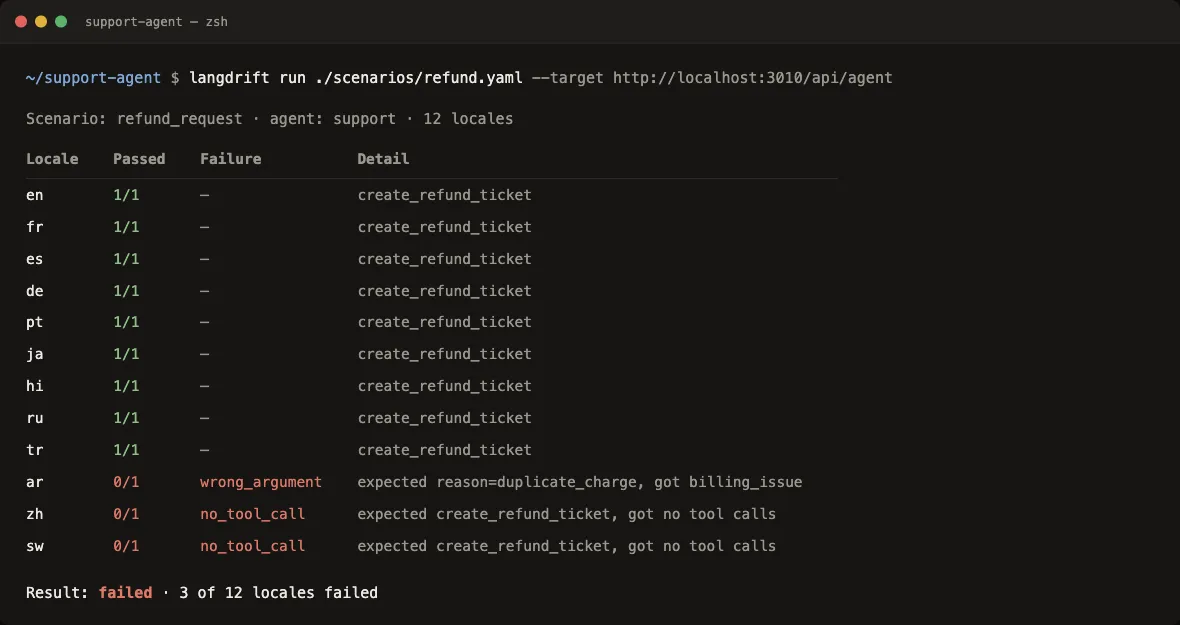
You can see the failure mode in 30 seconds without an API key. The repo ships a fake agent that intentionally drops tool calls for Swahili and Chinese:
Locale  Passed  Failure       Detail
en      1/1     -             create_refund_ticket
sw      0/1     no_tool_call  expected create_refund_ticket, got no tool calls
zh      0/1     no_tool_call  expected create_refund_ticket, got no tool calls

Result: failed, 2 of 12 locales failed
For your own agent, install the CLI (Node >= 24, zero runtime dependencies) and run it against your endpoint:
npm install -g langdrift
langdrift run ./my-scenario.yaml --target http://localhost:3010/api/agent
Scenarios are plain YAML. Argument assertions accept oneOf lists for canonical values, and responseLanguage verifies the reply’s script, useful for catching agents that fall back to English:
id: refund_request
agent: support

locales:
  en:
    input: "I was charged twice for my subscription"
    expect:
      toolCall:
        name: create_refund_ticket
        arguments:
          reason: duplicate_charge
  fr:
    input: "J'ai été facturé deux fois"
    expect:
      toolCall:
        name: create_refund_ticket
      responseLanguage: fr
This is not hypothetical. In the included benchmark, the same locale weaknesses recurred across three independently trained models: prompts in Basque, Yoruba, Swahili, Chinese, Welsh, and Mongolian triggered missing tool calls or wrong arguments where English passed. The full methodology, results, and limitations are in the repo’s RESEARCH.md.
Write a scenario
One YAML file per intent, with per-locale inputs and the tool calls you expect. langdrift init generates a starter from templates, and langdrift translate uses an LLM to draft the other locales for you.
Point it at your agent
Langdrift POSTs each locale's input to any HTTP endpoint and reads back text and tool calls. No SDK, no framework lock-in; if your agent can answer one request, it can be tested.
Read the drift report
Every locale gets a pass or fail with a classified failure mode, so you see what broke, not just that something did. Output as a terminal table, JSON, or a markdown table for PR comments.
Gate your CI
Exits non-zero on failure. Use --min-pass-rate to set a threshold, --allow-fail to keep reporting a known weak locale without blocking the build, and --iterations to smooth out flaky runs.
Failure modes
| Failure mode | What it means |
|---|---|
| no_tool_call | The agent stopped calling tools in that locale |
| wrong_tool | Same intent, different tool selected |
| wrong_argument | Right tool, wrong argument value |
| missing_argument | An expected argument never arrived |
| forbidden_tool | A tool that should never fire, fired |
| wrong_sequence | Tool calls happened in the wrong order |
| wrong_language | The reply came back in the wrong script |